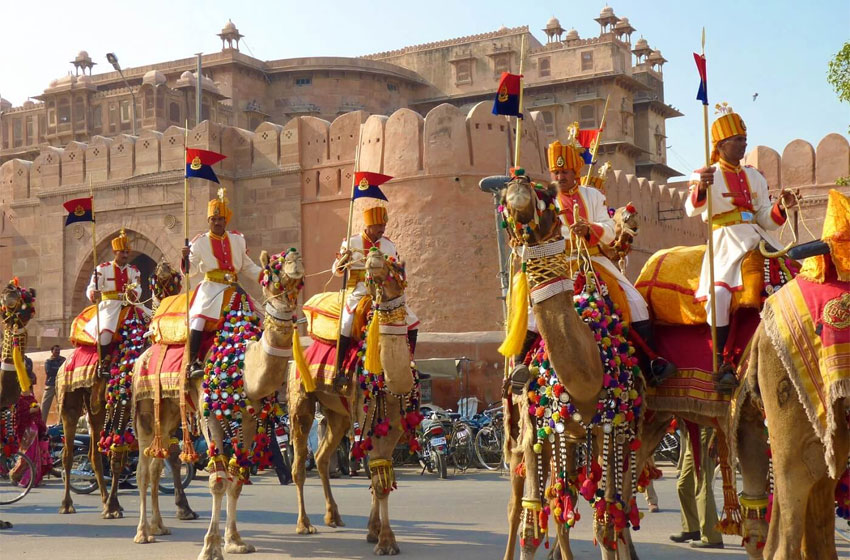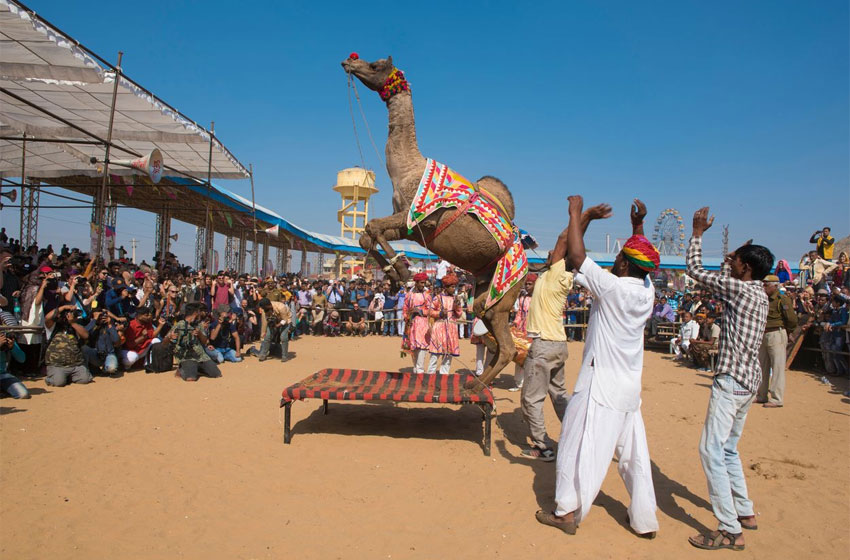
The Pushkar Camel Fair brings traders, herders, pilgrims, local families, and visitors to the small Rajasthan town of Pushkar for an event unlike the state’s palace-centered celebrations. Camels and horses gather on the sandy grounds outside town, while religious activity takes place around Pushkar Lake and its ghats.
For travelers interested in photography, regional traditions, livestock trading, and Rajasthan’s religious life, the fair can add considerable depth to a private journey through the state.
The experience, however, depends greatly on timing. The livestock activity, cultural programs, and religious observances do not necessarily peak on the same days. We plan a private Pushkar Camel Fair tour around the aspects that interest you most rather than simply booking accommodation for the official festival dates.
The fair takes place each year around KartikPurnima, the full moon of the Hindu month of Kartik. Dates therefore change annually.
Pushkar Fair 2026: November 17–24
Dates for future editions should be updated once officially announced by Rajasthan Tourism.
Travelers should also understand that the official fair dates do not always tell the complete story. Livestock traders may arrive before some scheduled events and leave as the fair progresses. If seeing large numbers of camels and horses is a priority, arrival timing deserves particular attention.
Pushkar has long been associated with livestock trading, particularly camels and horses brought to the area by pastoral and farming communities from Rajasthan.
Over time, the gathering developed into a much larger event. Trading continues alongside competitions, cultural programs, temporary markets, food stalls, and public activities.
At the same time, Pushkar is an important Hindu pilgrimage town. The fair period leads toward KartikPurnima, when pilgrims gather around Pushkar Lake for religious observances.
These two sides of Pushkar—the trading grounds and the sacred town—make the fair more interesting than a conventional cultural festival.
The livestock grounds are one of the main reasons international travelers come to Pushkar during the fair.
Traders arrive with camels and horses, temporary camps appear across the sandy landscape, and negotiations take place between buyers and sellers. Conditions are informal and can change substantially from one day to the next.
Early morning and late afternoon can be particularly rewarding for photography, when activity on the grounds combines with softer desert light.
A private guide helps provide context and allows your visit to be timed according to actual conditions rather than a rigid sightseeing schedule.
Pushkar Lake is central to the town’s religious identity. More than 50 bathing ghats surround the water, where pilgrims perform prayers and ritual bathing.
During the fair period and around KartikPurnima, religious activity increases considerably.
Visitors should approach the ghats respectfully. Photography may be inappropriate during certain ceremonies, and shoes need to be removed in designated religious areas. Your private guide can explain local etiquette before entering.
Pushkar is closely associated with Lord Brahma, and the town’s Brahma Temple is an important pilgrimage site.
A visit provides useful religious context for understanding why Pushkar attracts pilgrims independently of the camel fair itself.
Festival periods can mean larger crowds and waiting times, so the visit should be scheduled carefully within the wider day.
Pushkar has long attracted photographers because so many different elements come together within a relatively compact area.
Camel handlers, horses, temporary camps, traditional dress, pilgrims, religious ceremonies, and the desert setting can all provide strong photographic subjects.
For serious photographers, we recommend planning specific early-morning and late-afternoon sessions rather than treating photography as something squeezed between sightseeing stops.
It is equally important to photograph people respectfully. Permission should be sought when appropriate, particularly for close portraits and religious activities.
Accommodation requires early attention during the fair.
Pushkar has permanent hotels and resorts, while temporary tented camps may also operate during the festival period. Quality varies considerably, particularly among seasonal camps.
For a high-end Rajasthan trip, we assess accommodations according to privacy, room or tent standards, service, location, dining, and access to the areas you actually want to visit.
Some travelers may prefer staying close to Pushkar, while others may choose accommodations that provide greater comfort even if additional driving is required.
Pushkar can be incorporated easily into a broader luxury Rajasthan tour.
Jaipur is a natural addition and gives first-time visitors access to Amber Fort, City Palace, excellent hotels, and private shopping experiences. Nearby Ajmer may also be included depending on your interests.
With more time, the route can continue toward Jodhpur and Udaipur, creating a private journey through several of Rajasthan’s most important historic cities.
Your arrangements can include:
For most travelers, two to three nights works well during the fair.
Two nights may be sufficient if Pushkar is one stop within a longer Rajasthan itinerary. Three nights provides greater flexibility for photography, repeated visits to the fairgrounds, religious sites, and changes in the daily program.
Travelers whose main interest is professional or serious amateur photography may benefit from staying longer.
More important than the total number of nights is choosing the right dates within the fair period, particularly if livestock activity is your priority.
Tell us what interests you most about Pushkar - photography, the camel and horse fair, religious traditions, or a combination of all three.
Luxury Trip To India can incorporate the Pushkar Camel Fair into a private Rajasthan itinerary with carefully selected accommodations, personal guides, chauffeured transportation, and enough flexibility to experience the fair at the times that matter most.
Get In Touch
No planning fee, no obligation. A curator replies within two hours - or call +91 97990 02277.